
Winum verification guide – updated 29 September 2026
Winum KYC: Verification Before Withdrawals
 Available in GB
Winum can require identity verification before withdrawals and during other compliance checks. Current Winum KYC material lists identity, address and, in some cases, source-of-funds evidence, while the account terms also allow checks on payment ownership. This does not mean every player follows the same fixed checklist. The trigger and depth of review can depend on the withdrawal, transaction pattern, account history and risk assessment. For a UK reader, the practical point is to keep account details accurate from registration and expect a cashout to pause if requested evidence has not been supplied. The current policy also gives a 30-day response window for a KYC request, but that is a deadline for responding, not a promise that verification itself will be completed within 30 days.
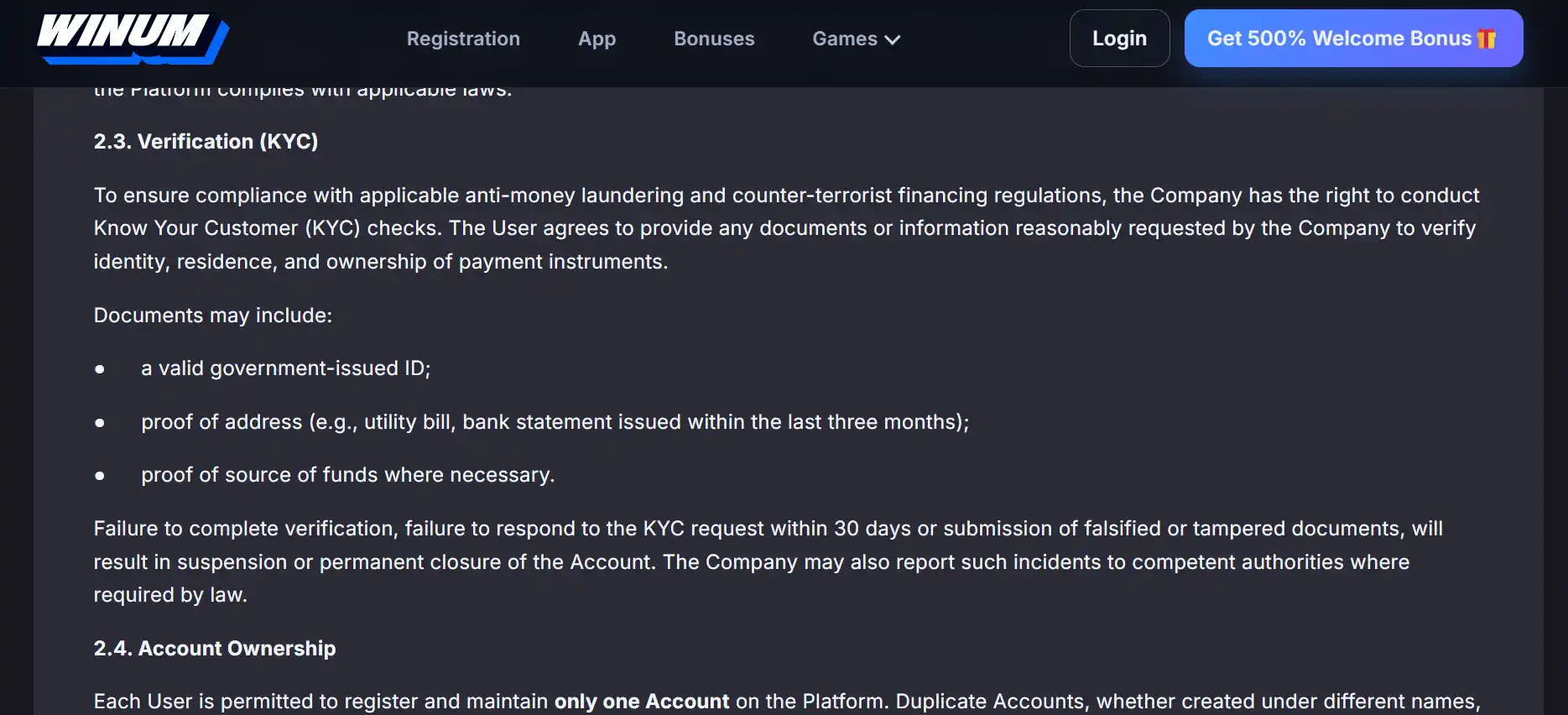
Table of Contents
- When Winum says KYC can be triggered
- Current document classes listed by Winum
- The 30-day rule is a response deadline, not a processing promise
- How KYC connects to registration details
- What enhanced checks can add
- KYC and withdrawals are connected but not identical
- How to handle a Winum verification request safely
- What this KYC evidence does not prove about UK regulation
- Where KYC fits into Winum account and withdrawal checks
When Winum says KYC can be triggered
Current Winum material treats KYC as a risk-based compliance process rather than a one-time formality attached only to signup. The KYC policy says verification may be requested before access to financial services, before withdrawals, or where a transaction is considered significant or high-risk. It also describes customer due diligence at a first withdrawal and additional scrutiny where activity appears unusual or needs closer review.
The account terms add another layer. They allow Winum to request information that verifies identity, residence and ownership of payment instruments, and they permit additional checks during account or transaction reviews. A player who has already deposited and played can therefore still encounter a verification request later.
The useful question is not simply whether Winum has KYC. The current evidence says it does. The more useful question is what triggered the check and which evidence the live request actually asks for. A withdrawal-related review is especially relevant, so the separate withdrawals page explains how verification fits into the cashout process.
Current document classes listed by Winum
Document requirements can change, so the details below are limited to what current first-party Winum material supports.
| Verification area | Examples currently listed | What to check |
|---|---|---|
| Identity | Valid passport, national identity card, driver’s licence, or another recognised official document. | The image should be clear, current and match the personal details on the account. |
| Address | Recent utility bill, bank statement or another official address document, with a three-month recency window described in the policy. | Name and residential address should match the account record. |
| Additional identity check | Selfie with the identity document, video verification or another authenticity check may be requested. | Follow the live instruction instead of assuming this is required for every account. |
| Source of funds | Source-of-funds evidence can be requested in enhanced or higher-risk reviews. | Provide only the evidence requested for the specific review. |
| Payment ownership | The terms allow checks on ownership of payment instruments. | Payment details should belong to the account holder and match the transaction being reviewed. |
The list is the current policy framework, not a guarantee that every user will be asked for every item. A live KYC request can be narrower or broader depending on the reason for review. If the dashboard asks for a particular document, that live instruction is more relevant than an old review, saved image or generic checklist.
The 30-day rule is a response deadline, not a processing promise
Winum’s current KYC policy and terms describe a 30-day period for responding to a KYC request. The important distinction is what that number means. It is the period in which the user is expected to provide requested information or documents. The material does not establish a universal 30-day verification processing time, nor does it promise that every review will finish within a fixed number of hours or days.
A review may require follow-up if an image is unreadable, an address does not match, a payment instrument needs ownership evidence, or a source-of-funds question is raised. Current terms also allow temporary holds while verification or security checks are in progress. That makes it misleading to turn the response deadline into a quoted “KYC time”.
If a withdrawal is waiting on KYC, respond promptly to the exact request and keep the case reference or support conversation. Do not repeatedly submit different versions of the same evidence unless Winum asks for a replacement, because conflicting information can make the review harder to resolve.
How KYC connects to registration details
KYC is easier when the account begins with accurate information. Winum’s terms require personal information to remain accurate, current and complete. The registration guide therefore recommends using real identity and residence details from the start instead of treating verification as a future problem.
Small inconsistencies can become important later. A shortened surname, outdated address, different date of birth, or payment method in another person’s name may create questions when account data is compared with documentary evidence. The policy is designed to establish identity, residence and transaction legitimacy, so consistency across those records matters more than how quickly the original registration form can be completed.
For a UK reader, residence accuracy is also important because the available evidence does not establish that the United Kingdom is presently available in the live registration selector. KYC should never be used to “fix” a country choice that was false at signup. If account jurisdiction data is wrong, the safer route is to contact support rather than trying to manufacture matching evidence.
What enhanced checks can add
The current KYC policy describes enhanced due diligence for higher-risk users or transactions. It says this can include additional document requests, independent third-party verification, source-of-funds checks and increased transaction monitoring. The policy also states that external verification providers may be used.
This does not imply that every routine withdrawal automatically triggers a full enhanced review. It means the KYC framework has more than one level. A basic identity-and-address check and an enhanced source-of-funds review are not the same process, even if both appear to the user under a general “verification” label.
If the operator asks for source-of-funds evidence, focus on the specific period, transaction or funding source named in the request. Do not upload unrelated financial records merely because a generic casino guide says they are “usually required”. The current Winum request should define the scope, and sensitive records should be submitted only through the verified platform or verified support route.
KYC and withdrawals are connected but not identical
A withdrawal can depend on successful verification, but KYC is not the only reason a cashout might take longer. Current Winum terms also mention payment-provider limits, transaction monitoring, method-specific rules and possible reviews for suspicious or irregular activity. The payment route itself can affect timing.
That is why this page does not publish a single “Winum KYC withdrawal time”. The current evidence does not support one universal number. It is more accurate to separate the operator’s verification step from the later payment-processing stage. Once KYC is complete, a payment provider or bank may still have its own processing window.
Likewise, completed KYC does not prove a specific withdrawal limit or fee. Those values can vary by payment method, verification level, account status and jurisdiction. Where exact cashout conditions matter, use the live withdrawal interface and the dedicated withdrawal guide rather than carrying numbers from an unrelated account.
How to handle a Winum verification request safely
- Open the request through the verified account environment: do not upload identity documents through a link from an unsolicited message.
- Read the request literally: send the category and format asked for instead of a broad collection of unrelated files.
- Check account consistency: name, date of birth and address should align with the profile unless support has first corrected an error.
- Use clear images: current Winum policy says submissions must be clear and legible.
- Respect the response window: current material gives 30 days to respond to a KYC request, but that is not a completion guarantee.
- Keep a record: save the support reference or date of submission if a withdrawal is waiting.
- Escalate through verified support: if a request is unclear, ask which document category is required instead of guessing.
Current Winum support material routes verification questions through account or support channels. Sensitive identity data should never be shared in a public forum, review-site comment or unrelated social account.
What this KYC evidence does not prove about UK regulation
A detailed KYC policy is evidence that Winum describes an identity and anti-money-laundering process. It is not evidence that Winum holds a UK Gambling Commission licence. The site’s licence context page treats licensing separately because local authorisation is a distinct fact that requires regulator evidence.
The same separation applies to account availability. A KYC page can exist globally even if a particular country is not offered in the live registration flow. For that reason, Winum’s verification policy alone does not establish that UK residents are definitely accepted or definitely blocked.
This distinction keeps the page useful without stretching compliance language beyond what it supports: Winum has current KYC procedures, those procedures can affect withdrawals, and exact UK operational acceptance must be checked separately.
Where KYC fits into Winum account and withdrawal checks
For a Winum user, KYC sits between account identity and payment access. The strongest current evidence shows that verification can be triggered before withdrawals or for wider compliance reasons, and that the operator may ask for identity, address, payment-ownership or source-of-funds evidence depending on the case. Current first-party material also gives a 30-day response deadline for KYC requests without promising a fixed verification completion time.
The practical sequence is straightforward: register with accurate details, use payment methods you can legitimately document, respond to the exact KYC request through a verified channel, and keep the verification issue separate from broader questions about UK licensing or country acceptance. The full review keeps those wider dimensions separate. That approach matches the current evidence without turning a risk-based review into a fictional universal checklist.
Created by the ”Winum Casino” editorial team.